Every blockchain has a way to represent things people own. On Ethereum and the chains built like it, that way is the ERC-20 token: a contract that keeps a list of balances and lets them move from one address to another. It is simple, universal, and it is the reason tokenization has come as far as it has.
It is also the reason tokenization has stalled where it has. A tokenized share, a bond, a fund unit and a memecoin are all the same thing to an ERC-20 contract: a number in a mapping. Everything that makes a share a share, the right to its income, the right to vote, the rules about who may hold it, lives somewhere else, enforced by an application or by trust.
AE-20 is Aeva's answer to that. It is the standard every asset on Aeva follows, and it is designed around what an asset actually is.
An asset, not a token
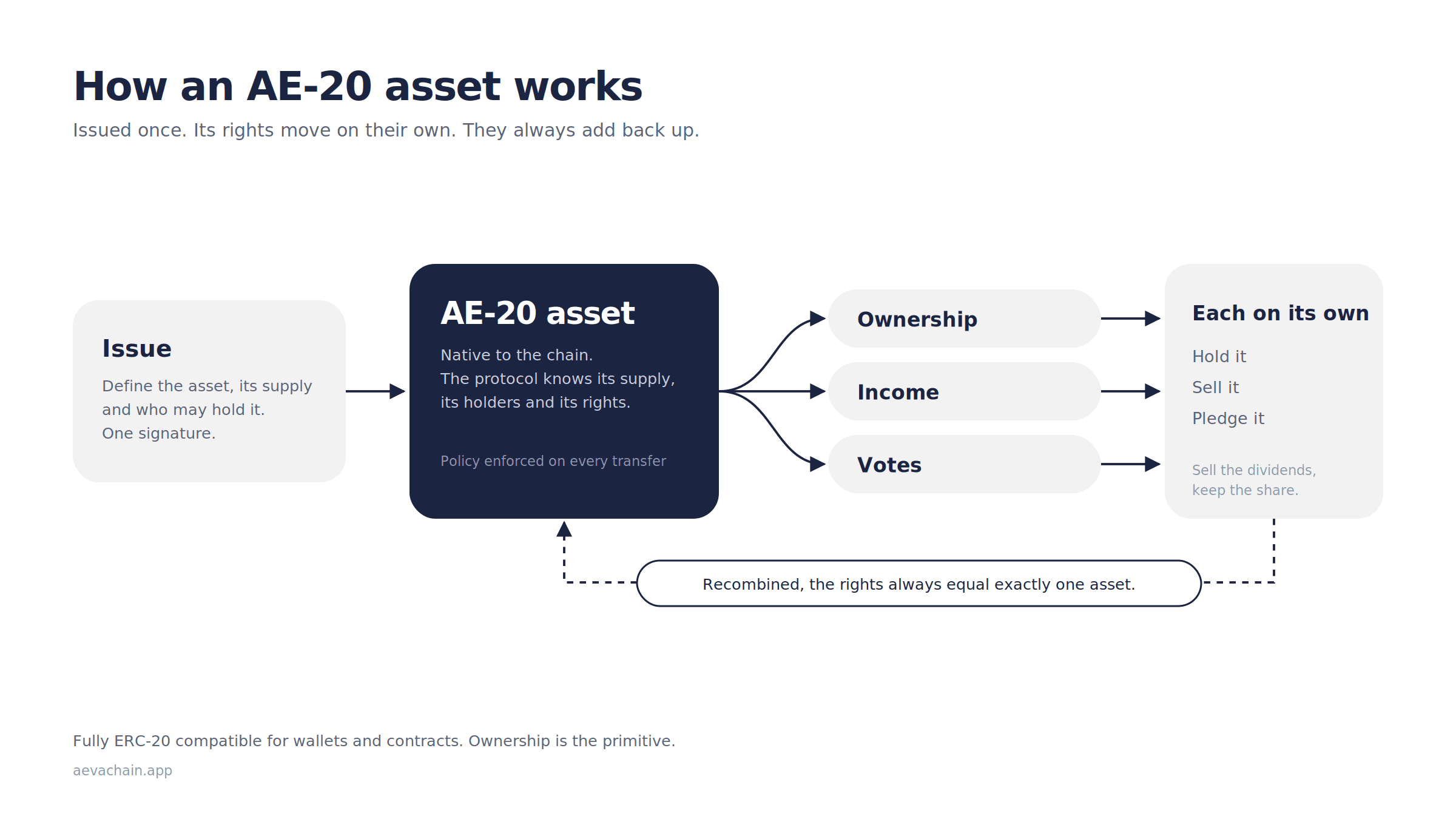
An AE-20 asset is a native object of the Aeva chain. The protocol itself knows it exists, knows its supply, knows its policy, and knows who holds which of its rights. It is not a contract that claims to be an asset; it is an asset the chain understands.
That single difference is what everything else follows from.
Rights are separate objects
An AE-20 asset carries its rights as first-class objects in the protocol: economic ownership, the right to its income, the right to vote, and others such as collateral claims and redemption. Each right can be held, transferred, sold or pledged on its own.
So a holder of 100 units does not simply hold 100 tokens. They hold 100 units of ownership, and, separately, the income right to those units, and the vote right. They can sell next year's dividends and keep the shares. They can pledge the shares as collateral and keep collecting the income. On a token, none of that is expressible.
Conservation of rights
The chain enforces one rule over all of this: the rights derived from an asset can never exceed the asset itself, and recombining them reproduces the original position exactly. Split a share into its income right and its ownership, sell the income right, buy it back, and you hold exactly one whole share again. This is checked by the protocol on every block, alongside the chain's other invariants. If it ever failed to add up, the chain would halt rather than continue.
Rules travel with the asset
An AE-20 asset carries its own policy: open to anyone, restricted to holders with a credential, subject to a lockup, or requiring the issuer's approval. The chain enforces the policy on every transfer and every settlement, regardless of which application is in front of it. Compliance is a property of the asset, not a feature of an app.
Income, paid by the chain
Income on an AE-20 asset is not an airdrop script. The chain tracks what every holder of the income right is owed, and routes each payment to them when it is distributed. If the income right has been sold, the payment follows the right, not the original holder.
Settlement in one block
Two AE-20 assets, or an asset and aeUSD, can settle against each other atomically: both legs move in the same block, or neither does. Delivery versus payment is a protocol operation, not a pattern built on escrow contracts.
Fully ERC-20 compatible
For the EVM side of Aeva, every AE-20 asset also exposes an ERC-20-shaped interface through the chain's precompiles. Wallets see a balance. Pools can trade it. Contracts can hold it. The compatibility is complete, but it is a window onto the asset, not the asset itself. Behind that window, the rights, the policy and the settlement logic remain native.
How to issue one
Issuing an AE-20 asset takes six steps in the Aeva app, under Tools → Issue:
Define the asset: name, symbol, supply.
Attach its rights: ownership, income, votes.
Set its policy: who may hold it, lockups, issuer approval.
Issue it to the initial holders.
Distribute income when it is due.
Export the cap table, straight from chain state.
The issuer signs once. The chain does the rest.
What is live
On the Aeva testnet, AE-20 assets have been live for some time: test assets that pay income every hour, and everything above can be tried with test tokens from the faucet.
On mainnet, aeva-1, the standard is live from genesis. Issuing an asset there requires AEVA for fees, which holders will be able to bring over once the bridge from Robinhood Chain opens, together with aeUSD as the settlement currency.
Aeva does not review or approve issuances. What can be issued, and to whom, is the issuer's responsibility under the laws that apply to them.
Why it matters
Tokenization put assets on-chain. AE-20 lets the chain understand them. That is the difference between a token that represents an asset and infrastructure that can settle, pay and govern one, and it is the layer real markets will need as they move on-chain.
Ownership is the primitive.